Grace, ME

Lifestyle

Lifestyle Blog

An Autumn Practice for Savoring, Simplicity, and Intuition

October is a month for savoring. The leaves turn, the air cools, and the season invites us to simplify.
This month’s practice is about making ordinary moments feel sacred, listening to your intuition, and letting autumn teach you how to release what no longer needs to be carried.
“I’m so glad to live in a world where there are Octobers.” — Anne of Green Gables

Begin with a cozy ritual

As the weather cools, a bath, candle, warm drink, or quiet evening can become more than self-care. It can become a ritual.
Try a hot bath with epsom salt by candlelight. As the air dries and cools maybe give your hair and skin some extra hydration. A little face or hair mask can help your body transition. Choose a book, movie, or show that helps you romanticize Autumn.
The details matter less than the attention you bring. A ritual is powerful because it helps you pause, receive, and return to yourself.

Adapt your morning routine to autumn

Autumn mornings can feel different. The air may be cooler, the light softer, and your body may ask for a gentler beginning.
Instead of forcing the same routine you used in summer, try adapting your mornings to the season.
You might:
  • Wake up with a warm drink
  • Add a few grounding breaths before checking your phone
  • Choose slower movement
  • Step outside and feel the air
  • Light a candle while you get ready
  • Give yourself a few extra minutes instead of rushing
Seasonal living is not about doing more. It is about noticing what supports you now.

Savor simple pleasures

Take time to enjoy simple pleasures this autumn.
Listen to the crunch of leaves under your feet. Wrap your hands around a hot cup. Light a candle to turn a normal activity into a ritual.
Your home is your sanctuary. Every little moment you pause and enjoy can help your nervous system associate home with regulation and safety. You have the power to transform little moments into medicine.
This is yoga too: attention, presence, and the willingness to receive the moment you are in.

Listen to your intuition

The third eye chakra is connected to intuition, imagination, insight, and the witness self.
Have you ever had a feeling about something and then you were right? Or thought about an old friend, only to have them text you the same day? This is the kind of subtle knowing that many people have experienced in one way or another.
To nurture this part of yourself, spend time noticing your inner witness.
You might:
  • Meditate
  • Journal
  • Pull a tarot card
  • Notice your feelings without immediately explaining them away
  • Ask what you already know
Beyond the conscious mind is a deeper layer of understanding and guidance. Autumn is a beautiful season to listen.

Let autumn simplify your practice

As the leaves let go, ask yourself: what can I release?
Autumn is the perfect time to simplify your practice. You do not need the most elaborate routine to receive the benefits of yoga.
Try this:
  • Three conscious breaths
  • One grounding pose
  • One moment of stillness
Sometimes the most powerful practice is the simplest one.

An October reminder

October does not ask you to rush. It asks you to notice.
Notice the candle. The warm cup. The leaves underfoot. The quiet inner knowing. The breath that brings you back.
Let this month be a practice in savoring, simplifying, and listening.
An Early Autumn Practice for Clarity, Grounding, and Mindful Change

September is a threshold month. The light softens, the air begins to shift, and autumn slowly asks us to come back to ourselves with more clarity, steadiness, and intention.

This month’s practice is about communication, energetic reset, home practice, and simple grounding. As summer collapses into fall, you do not have to overhaul your life. You can begin with your words, your space, your breath, and your feet on the floor.

Speak with clarity

Clearly communicating can change your life.

The words you choose shape how you see yourself and how others understand you. In yoga, this connects beautifully with the throat chakra: the energy center associated with expression, truth, listening, and communication.

When this energy feels overactive, you may find yourself babbling, over-explaining, or speaking without fully considering the impact of your words. When it feels depleted, it can be hard to speak up, make your needs known, or trust your own voice.

A few simple ways to support your throat chakra:

  • Sing in the car
  • Pause before choosing your words
  • Notice whether your language supports the person you are becoming
  • Practice naming what you need with kindness and clarity

Your voice is part of your practice.

Reset the energy of your home

Autumn is a beautiful time to clean your home like you are resetting the energy, not just managing the mess.

This does not have to mean a dramatic deep clean. It can be as simple as clearing one surface, opening a window, lighting a candle, or putting away the things that no longer belong in the space you are trying to create.

When you clean with intention, the act becomes ritual. You are not just tidying. You are telling your nervous system: this is a place where I can land.

Prepare for a home yoga reset

Autumn is also a natural time to return to daily practice. The days are shorter and welcome you into a cozy home body phase of the year.

Consider joining us for The Autumn 30 Day Home Yoga Reset to get your cozy season on track. Starting October 9 and ending November 7 you will receive daily emails with links to a curated, under 30 minute, free yoga practice from YouTube, a playlist to match, and other inspirational goodies to keep you going. You can join for some, join for all, but most of all, enjoy.

A home yoga reset does not have to be about perfection. It is about creating a rhythm you can return to. Thirty minutes, ten minutes, or even a few breaths can help you remember that your practice belongs in your real life.

JOIN

Anchor to gratitude with the new moon

This time of year can be unsettling as the change moves around us without our permission. The new moon offers a monthly pause point.

Before moving into the next thing, take time to reflect on the month that has passed. What are three things you are thankful for right now?

Gratitude is not about ignoring difficulty. It is about training your brain to notice the ways life is also supporting you. Positive psychology teaches us that thankfulness can help boost happiness, and yoga invites us to embody that gratitude through breath, awareness, and presence.

Try this: place your feet on the ground, take one slow breath, and name three ways the universe has had your back this month.

Make home practice easier

One of the best ways to maintain a home yoga practice is to reduce resistance.

That means you do not need a complicated ritual before getting on your mat. You need a setup that makes practicing easier.

For example:

  • Communicate with the people in your home so they know you are practicing
  • Make sure pets have what they need and are safe
  • Keep your space ready so you do not have to set it up from scratch
  • Choose your music and video ahead of time
  • Let go of needing special clothing or perfect conditions

The goal is not to create more steps. The goal is to remove the steps that keep you from beginning.

Ground between responsibilities

As patient loads, work demands, or seasonal responsibilities increase, boundaries become even more important.

Try this grounding technique between charts, tasks, or transitions:

  1. Feel your feet on the floor.
  2. Notice three things you can see.
  3. Take two deep breaths.
  4. Observe one body sensation.

Small reset moments add up to sustainable practice.

Three ways to thrive in autumn

To support yourself as the season changes, keep it simple:

  1. Get enough sleep.Autumn asks for steadiness. Sleep is one of the most foundational ways to support your body and mind.
  2. Feel your feet on the ground.When life feels scattered, grounding can begin physically. Let your feet remind you that you are here.
  3. Take time before making decisions.You do not have to respond immediately. Give yourself space to feel, breathe, and choose.

A September reminder

“September came in with golden days and silver nights.” — J.R.R. Tolkien

Let this month be golden and grounded. Speak clearly. Reset your space. Prepare for practice. Give thanks. Feel your feet on the floor.

Autumn does not require you to become a new person overnight. It simply invites you to return to what steadies you.

A Late Summer Practice for Cooling, Strength, and Steadiness

August has a particular kind of fullness. The light is still long, the days can still feel hot and active, and yet there is often a quiet shift in the background. Summer is not over, but it may be asking us to practice in a more intentional way.

This month’s invitation is to stay connected to your body, your rhythms, and your capacity for steadiness. That might mean cooling rituals, simple breathwork, mindful movement, or a more compassionate relationship with stress.

Romanticize the small rituals

One of the sweetest ways to care for yourself in late summer is to let your daily rituals feel a little more beautiful.

Try a cool to lukewarm bath with a small amount of rose water. Put cut flowers somewhere you can see them. Choose a book, movie, or show that helps you romanticize summer in a grounded, nourishing way.

This does not have to be extravagant. A ritual is not powerful because it is complicated. It is powerful because it invites your full attention.

When the season feels hot, busy, or overstimulating, a simple cooling ritual can become a way to return to yourself.

Plan with the moon, not against yourself

The moon offers a natural rhythm for reflection, intention, action, and release. You do not need to overthink it or turn it into another productivity system.

A moon-based monthly practice can be cozy and grounded:

  • Use the new moon to reflect and set intentions
  • Let the waxing moon support small, steady action
  • Use the full moon to notice what is illuminated
  • Let the waning moon help you release what no longer needs your energy

Planning with the moon can be less about doing more and more about remembering that you are cyclical too.

Begin the workday with cooling breaths

If work-life balance feels challenging in summer, especially in a caregiving or patient-facing role, mindful morning moments can help you enter the day with more steadiness.

Before your first patient, client, meeting, or task, try three cooling breaths:

  1. Inhale through slightly pursed lips.
  2. Exhale slowly.
  3. Let your shoulders soften before the next breath.

Controlled breathing can support the nervous system, and even a few intentional breaths can change the way you meet the next moment.

You do not need a full hour-long practice before work to benefit from yoga. Sometimes the practice is three breaths before you walk into the room.

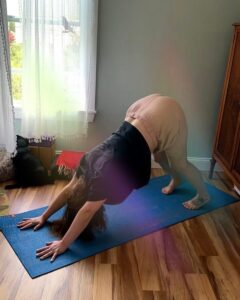
Revisit downward facing dog with care

Downward facing dog is often treated like a basic yoga pose, but it is actually a complex posture. It is also an inversion, meaning the head is lower than the hips.

There is a lot happening in the body at once. The shoulders, spine, hamstrings, hands, and hips all have to work together. Because of that, it is worth approaching this posture with curiosity rather than forcing yourself into a shape.

A few supportive cues:

  • Tuck the tailbone slightly to avoid overstretching the hamstrings.
  • Imagine your sit bones pointing toward your heels.
  • Press into your fingertips, not just the heels of the hands.
  • Let the shoulder blades slide toward the little fingers.
  • Let the head hang naturally instead of gripping through the neck.

Downward dog does not have to look a certain way to be useful. Let it become a conversation with your body.

Use the new moon for gratitude

The new moon is also a beautiful time to reflect on the month that has passed.

Ask yourself: what are three things I am thankful for right now?

Gratitude is not about ignoring what is hard. It is about training your brain to also notice what is supportive, beautiful, and steady. Positive psychology reminds us that thankfulness can support happiness, and a yoga practice can help us embody that gratitude rather than just think about it.

Place one hand on your heart, take a slow breath, and name three ways life has supported you this month.

Let summer activity build gradually

Summer often brings more movement: morning walks, evening strolls, beach days, carrying chairs and bags across uneven sand, longer outings, and more time outside.

Ideally, the strength and balance work you practiced in cooler seasons helps support you now. It takes about six to eight weeks of consistent loading to build strength in a muscle, which means that the quiet work you do over time really does matter.

If you are increasing activity, do it gradually. Try to keep your activity level somewhat consistent day to day, then build up to longer or more challenging activities over time.

This is especially important if you are noticing arthritic joint changes or if your body feels less forgiving than it used to. Your body can adapt, but it appreciates a gradual introduction.

Safe and sustainable activity is still progress.

Let stress become a teacher

We tend to demonize stress, but both science and yoga remind us that nothing is absolute. There is such a thing as positive stress, also called eustress.

The question is not only how much stress you experience. It is also how you relate to it.

This is one reason yoga can be so beneficial. Your practice gives you a place to meet challenge on purpose. You can notice discomfort, breathe, soften unnecessary tension, and practice responding with grace and compassion.

That does not mean pushing past your limits. It means learning the difference between a challenge that supports growth and a signal that asks you to pause.

A helpful practice question is: can I stay kind to myself while something feels difficult?

A practice for late summer

This August, let your practice be both grounding and responsive.

Cool down when you feel overheated. Add beauty to the small rituals. Breathe before the day begins. Move with respect for your body’s complexity. Build strength gradually. Let gratitude and the moon remind you that you do not have to live in a straight line.

Your yoga practice is not only what happens on the mat.

It is the breath before work. The bath at the end of a hot day. The way you carry your body across the sand. The pause before reacting to stress. The gratitude you choose to name.

Let August be a month of steady, compassionate practice.

A Gentle Summer Practice for Gratitude, Cooling, and Ease

Over the next couple of weeks, the invitation is simple: let summer support you instead of asking yourself to push through it.

Summer can be bright, full, social, and energizing. It can also feel hot, overstimulating, and a little scattered. Your yoga practice does not have to look the same in every season. In fact, one of the most supportive things you can do is let your practice meet the moment you are actually in.

Begin with gratitude

The new moon offers a natural pause point. It is a quiet reminder to look back before rushing forward.

Take a few minutes to reflect on the month that has passed. What are three things you are thankful for right now? They do not have to be big. They might be a cool breeze through an open window, a conversation that softened something in you, or one small promise you kept to yourself.

Gratitude is not about pretending everything is perfect. It is a way of training the mind to notice where support is already present. Positive psychology reminds us that a thankfulness practice can help boost happiness, and in yogic practice, this kind of attention can become a doorway into steadiness.

Try this: place one hand on your heart, take three slow breaths, and name three ways the universe has had your back this month.

Let your home become a cooling sanctuary

If your practice feels too heated in summer, you are not doing anything wrong. Your body may simply be asking for something softer, slower, and more cooling.

Instead of forcing an intense practice during the hottest part of the day, try rolling out your mat in the morning or evening when the air feels a little gentler. Choose forward folds, gentle twists, restorative shapes, or a few minutes of breath awareness.

Your home practice can become a cooling sanctuary. It does not have to be long to be meaningful. Every breath counts.

A simple summer practice might look like:

  • A few breaths standing with bare feet on the floor
  • A slow forward fold with bent knees
  • A gentle seated twist on each side
  • Legs up the wall or another supported rest
  • One minute of gratitude before you move on with your day

Savor the little things

Summer also invites us to come back to simple pleasures.

Put your bare feet in the grass. Drink a cool glass of water slowly. Pause when a breeze moves through the room. Let yourself enjoy the small sensory moments that are already available.

These little pauses can help your nervous system register safety and ease. Your home is your sanctuary, not because it is perfect, but because you can create moments of regulation inside it. Every little moment you pause and enjoy can become medicine.

This is part of yoga too: noticing, softening, receiving.

Three ways to thrive in summer

Here are three practical ways to work with summer energy instead of against it:

  1. Use the longer days intentionally.

    Let the extra light support the things that matter, but resist the urge to fill every hour. More daylight does not have to mean more pressure.

  2. Avoid intense movement during the hottest part of the day.

    If you want to move, choose the cooler edges of the day. Let your practice be grounding rather than depleting.

  3. Pause before responding when heat rises.

    Summer intensity can show up emotionally too. If you feel anger, irritation, or impatience building, wait before responding. Take a breath. Feel your feet. Give your nervous system a moment to catch up.

A summer reminder

You do not need a perfect routine to care for yourself. You need a few honest moments of attention.

This season, let your practice be simple. Let it be cooling. Let it be something you can return to in the middle of real life.

Start with gratitude. Move gently. Savor what is small. Pause when the heat rises.

Your practice is allowed to change with the season — and so are you.

My Winter Home Yoga Practice

The new year is a time when for a moment we are inspired to look over our habits and re-establish patterns in our days that match your values and what we want out of life. However, this time of year is also when I mostly want to just sleep. I don’t want to get up early to exercise or meditate. I want mindless rest and sweet unconsciousness until the sun returns. That is why my winter home yoga focuses on leaning into rest. I can’t stop the rest of my life from pulling me out of bed. A little mindful, intentional, rest, gentle stretching, moving in ways that just feel good. Sometimes just lying on the floor with binaural beats if I don’t have energy for anything else.

So, what props and items do I actually use in my winter home yoga practice?

I actually use a candle, music, cozy blankets, anything to help me feel like I’m setting aside time for magic. On a practical level I have a yoga mat, bolster, cork blocks, foam blocks, massage balls, a feetup inversion stool, and a yoga blanket. When needed I pull in extra pillows and blankets from household items. I have had years to accumulate the things that make my yoga practice feel easy. I also have a dedicated area with blank wall space. I love a wall yoga practice.

In the winter I try to reduce any areas of resistance or barriers to participation in my home practice because it is just too easy to let the days go by without practicing. I leave my yoga mat out with some basic props within reach. I keep a few short favorite practices top of my home yoga Notion page. I also try to focus on more restful practices and practice in the afternoon/evening. My yoga is my wind down time. My me time after work.

How does your home yoga practice shift in the winter months?

A Restorative Practice for February

In the season of late winter early spring the dominant dosha is Kapha. Kapha represents the elements of earth and water and this is a time when nature shows us how to rest. However, since humans are not trees, we need to move in the world in winter in order to survive. This restful energy can become out of balance or excessive and turn towards depression or stagnation.

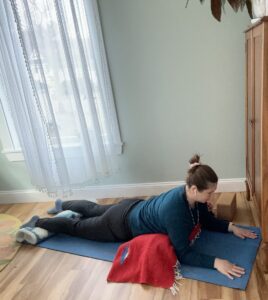
Remember that the intention of a restorative practice is to support your physical body until you do not feel tension or a stretching sensation. For this reason the more props, usually, the better! Gather a soft surface like a yoga mat or rug, a yoga bolster and/or pillows, a few blankets and maybe a block or similar object (book, small stool etc). I will be guiding you into a supported sphinx pose. Take a look at the picture and you may be able to anticipate your needs. In this posture you will lay on your belly so make sure you have a soft surface like a yoga mat, folded blanket, or both under your abdomen and legs. If you know that your ankles don’t like to be stretched in the front or you need a different angle for your knees try a rolled up blanket under the front of the ankles. You will want a pile of pillows or a yoga bolster under your chest to keep it lifted but supported. Finally find something like a yoga block to rest your head on.

To build the fire and balance winter’s natural low energy try focusing your attention on your inhalation. See if you can feel your inhalation go all the way from the top of your head to your toes. Make it long and slow. Then just let the exhalation happen without giving it as much of your attention. Imagine you can make the line from your head to your toes longer with every inhalation.

Rest. You can benefit for holding this posture as short as 1 minute and as long as 8 minutes. Pay attention to your body and practice giving it what it needs.

A Restorative Practice for January

In the season of late winter early spring the dominant dosha is Kapha. Kapha represents the elements of earth and water and this is a time when nature shows us how to rest. Societally January is the season of new year goals, intentions, and often new action towards healthier habits. However, it’s not a good time of year to keep that fire of action and change going. It may be more productive to take a beat and lean into Kapha Season. A time of rest, when the earth is calm and quiet.

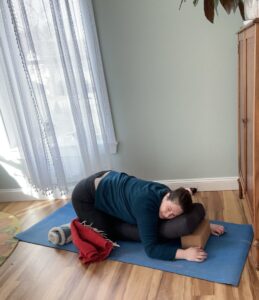
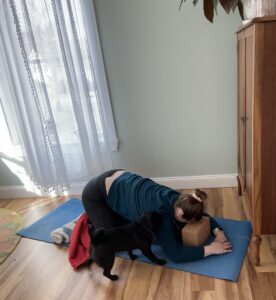
Remember that the intention of a restorative practice is to support your physical body until you do not feel tension or a stretching sensation. For this reason the more props, usually, the better! Gather a soft surface like a yoga mat or rug, a yoga bolster and/or pillows, a few blankets and maybe a block or similar object (book, small stool etc). I will be guiding you into a wide legged child’s pose. Take a look at the picture and you may be able to anticipate your needs. You can put a blanket behind your knees if end range bending is not comfortable. You can also put a blanket under your ankles if pointing your ankles feels like a stretch. You will want support under your trunk, pillows or bolster, and possibly under your forehead. If your head is turned be sure to turn your head the opposite way halfway through your practice.

When you are comfortable I welcome you to practice a simple pranayama. Start by noticing the length of your inhales and exhales. Then consciously make your exhales twice as long as your inhalations. If this is too much counting you can also just try to make your exhale as long as possible, but only to the point that it does not add tension to your body. Just the attention to your exhalation will help elongate it.

Rest. You can benefit for holding this posture as short as 1 minute and as long as 10 minutes. Pay attention to your body and practice giving it what it needs.

The 5 Koshas


You are more than your physical body. In yoga we honor 5 layers of our beings. These are called the Koshas and they include our physical, energetic, mental, soul and bliss bodies. These are in turn related to the 5 elements of earth, water, fire, air and ether. Consider putting energy into nurturing ALL parts of your being. Yoga offers so much more than a physical practice. I remember when I first learned about the Koshas I noted the similarity to Maslow’s Hierarchy of Needs from Psychology. These needs start with physiological, safety, belonging and love, esteem and finally end with self actualization. These needs and “bodies” help us imagine how to support not only ourselves but our community. The physical is where we start but we hope to move up the hierarchy from body and towards spirit.


The Annamya Kosha represents your physical body, the element of earth and as Maslow would say your physical needs. Think food, think health, think access to clean water. Consider honoring your Annamya Kosha, physical body, by taking a warm bath and going to bed early.


The Pranamyaya Kosha represents your energetic body, the element of water, and as Maslow would say your safety needs. Water element can represent the end of a cycle, intuition and high emotions. Consider taking care of your Pranamyaya Kosha by focusing on your own healing first. Your emotional needs are real and only you4e can find mastery of youe reality. Without this focus one can’t fully be of service to others.



Stop and notice your body. That part of you that can observe yourself is the Vijnanamaya Kosha. It represents your soul/wisdom body, the element of air, and as Maslow would say your need for esteem. You may choose to care for your Vijnanamaya Kosha by building space in my day to spend time by yourself in silence.


Have you ever gotten so involved in a conversation with someone who also feels passionate about a subject that you both loose track of time? That is the Manomaya Kosha. It represents your mental body, the element of fire and as Maslow would say your need for love and belonging. The connection of passion with intellectual life makes sense to me. The mind is more than a computing machine. It requires inspiration to grow. You can care for your Manomaya Kosha by staying intellectually stimulated by your work.



What is life without a spark of magic? The final kosha is Anandamaya Kosha represents your spiritual/bliss body, the element of spirit/ether and your need for self actualization. This is the magic and it is right here all the time. It is already a part of you. Honor your Anandamaya Kosha, spiritual/bliss body, by being present in this moment. Care for your Anandamaya Kosha by resolving to smile at the beauty of life every day.

Slow TV

I first heard the term slow TV from a friend who was visiting family in Norway. While she was there she watched a Slow TV of a train traveling along in the mountains for hours at a time. She noted how peaceful it was and how it seemed to typify the difference between the Norwegian and American pace of life. Having lived in Copenhagen for a semester in undergrad I immediately connected to this idea. Scandinavian culture values a cozy home life with rest, friends and simple pleasures. Wanting to bring a bit of that to my YouTube channel I started filming my own Slow TV episodes of nature in Maine. My videos are shorter than the inspiring train ride through the mountains of Norway but I hope they relay some of that slow life feeling. I love to have them on in the background as I putter around on days off. 


If this sparked a note of recognition you may be thinking of the background videos, most popular being the fireplace in winter. It seems that, as so often happens, others were seeking that cozy background from their media. I recently watched a hour long video of a walk through central park in the rain. The noise of the rain and the rhythm of walking was mesmerizing. I also enjoy the background videos of Hogworts common rooms, especially while feeling studious. Background sounds that add to the feeling of warmth and connection in a home are so valuable. It is also a good way to easily switch out one habit, having the tv on a show in the background at all times, for a new, similar, but more therapeutic habit. This is one of my favorite tricks.  


I, of course, would love you to enjoy my slow tv episodes of my beautiful state. Mine are much shorter than the hours long classic slow tv but I have put them in a playlist to help prolong the experience. I have also explored adding some calming music as is done in the background videos but not in the traditional slow tv. I’ll probably end up posting two versions of future slow tv episodes. One episode for when you just want ambient sound and one for when you need some music. One I made of Jasper beach I am especially proud of because of the amazing, calming, sound of that particular beach. When the waves come in and out the pebbles of that beach clink together and make a beautiful sound. This video is on my old channel so make sure to subscribe to my current channel for new content. 


No matter what you choose to watch try to make a mindful decision for your betterment and then make that decision a habit with repetition. Make it easy by making a playlist of your favorite videos. I have linked the ones I mentioned below. Put a reminder to try some slow tv in the place you usually reach for to put on the tv, such as your remote, tablet or computer. Take a moment to pause and enjoy your choice, noting how good it feels. This is the best mobivation you can have to perform this habit again tomorrow. Good luck yogis! 


Oxox,